Assyrtiko Wine: The Complete Guide
What Assyrtiko tastes like, why Santorini's version is different, the six styles worth comparing, food pairings, and how to taste it properly on the island.
If you drink wine in Santorini, one name appears almost everywhere: Assyrtiko. It is the island’s defining white grape, and the wine most closely tied to its volcanic landscape.
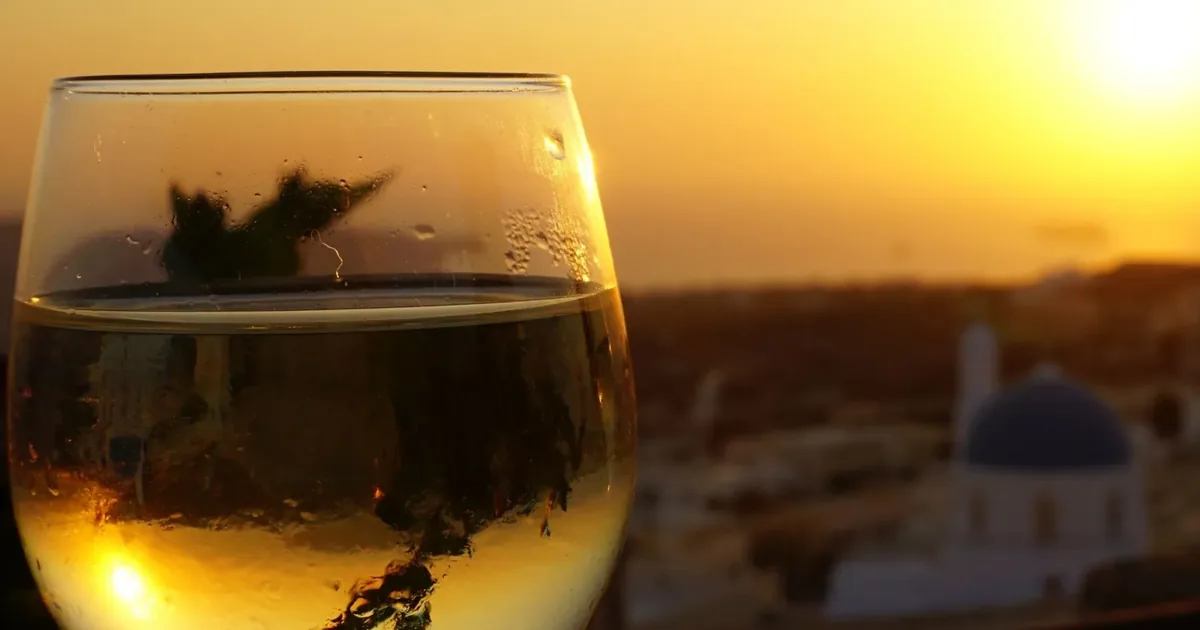
What makes it interesting is the contradiction between where it grows and how it tastes. Santorini is hot, dry and relentlessly sunny, and yet Assyrtiko holds on to remarkably high acidity. Add mineral-poor volcanic soils, wind, old ungrafted vines and those strange basket-shaped vineyards, and you get a wine that is genuinely difficult to reproduce anywhere else.
Check Availability
Assyrtiko at a glance
| Grape | Assyrtiko |
| Colour | White |
| Most famous region | Santorini, Greece |
| Typical style | Dry, high-acid white wine |
| Common flavours | Lemon, citrus peel, stone fruit, herbs, smoke, salt and mineral notes |
| Acidity | High |
| Sweetness | Usually dry; also used in sweet Vinsanto |
| Body | Medium to full, depending on winemaking |
| Best with | Fish, seafood, grilled octopus, shellfish, salty cheeses |
| Best place to taste it | At Santorini wineries, ideally comparing several styles side by side |
In simple terms: Assyrtiko is a dry Greek white known for sharp freshness, citrus character and a distinctive saline, mineral feel. Santorini is its historic home and still the most interesting place to taste it.
What is Assyrtiko wine?
Assyrtiko is a native Greek white grape variety most strongly associated with Santorini.
It is grown in other parts of Greece too, but Santorini remains the benchmark. On the island it goes into straightforward dry whites, richer single-vineyard wines, barrel-aged wines, traditional Nykteri and the sweet wine Vinsanto.
That range is one reason a Santorini wine tasting is more interesting than ordering “a glass of Assyrtiko.”
Two bottles labelled Assyrtiko can taste quite different depending on:
- where the grapes were grown;
- the age of the vines;
- the vineyard site;
- harvest date;
- whether the wine was fermented or aged in stainless steel, concrete or oak;
- time spent on the lees;
- whether the wine has been bottle-aged.
At its simplest, Assyrtiko is bright and refreshing. At its most ambitious it is structured, concentrated and capable of ageing for years.
What does Assyrtiko taste like?
The easiest way to recognise Assyrtiko is the combination of high acidity, citrus and a savoury saline character.
Typical flavours and aromas include:
- lemon;
- lime;
- grapefruit;
- green or yellow apple;
- white peach;
- stone fruit;
- dried herbs;
- smoke or flint;
- sea-salt or saline notes.
Not every Assyrtiko tastes like this. A young stainless-steel wine can feel very crisp and direct, while a barrel-aged version shows honey, nuts, spice, toast and a creamier texture.
The defining feature is usually the structure rather than any single aroma. Even in a warm Mediterranean climate, Santorini Assyrtiko stays remarkably fresh.
Is Assyrtiko sweet or dry?
Most Assyrtiko you meet as Santorini PDO white wine is dry.
But Assyrtiko is also one of the principal grapes in Vinsanto, Santorini’s traditional naturally sweet wine, for which the grapes are sun-dried before fermentation to concentrate their sugars and flavours.
So the grape does not determine the sweetness. The winemaking does.
Why does Santorini Assyrtiko taste different?
Santorini is an extreme place to grow vines. The island has:
- volcanic soils;
- very little summer rainfall;
- intense sunlight;
- strong winds;
- low vineyard yields;
- many old vines;
- very little clay in the soil.
Those conditions have shaped both the grape and the way growers cultivate it. The result is usually a wine with more concentration and more pronounced saline and mineral character than Assyrtiko grown somewhere gentler.
This does not mean every Santorini Assyrtiko tastes “like volcano.” Wine descriptions turn romantic very quickly. But taste several versions side by side and the combination of acidity, texture and savoury saltiness is hard to miss.
Santorini’s volcanic soil
Santorini was formed through repeated volcanic activity, and its vineyards grow in soils dominated by volcanic material rather than the fertile, clay-rich soils of most wine regions.
The ground holds volcanic ash and pumice, and it retains relatively little water. For the vines, that means stress.
Yields are naturally low, and growers work in an environment where water is scarce and the wind can be severe. That stress is part of why Santorini wines are so concentrated — and part of why the vineyards look nothing like the neat upright rows of Tuscany, Bordeaux or Napa.
Why are Santorini vines grown in baskets?
One of the first things you notice on a vineyard visit is that Santorini’s vines do not look like a vineyard at all.
Many are trained close to the ground in a circular basket shape called a kouloura. The canes are woven around themselves over years, creating a low basket, and the grapes ripen protected inside it.
The system shields the fruit from:
- strong Aegean winds;
- blowing sand and volcanic material;
- intense sun exposure.
The low shape also helps the vine use what little humidity there is. These baskets are labour-intensive to maintain and the yields are small, but they are the defining feature of Santorini viticulture.
Seeing them in person is one of the most useful parts of a wine tour. Without context the vineyards look almost neglected; once the system is explained, the whole landscape makes sense. The Wine Tasting Tour with Snacks (4.97 stars, 753 reviews, from $197) is the version we point most people at for this — twelve pours across three cellars, deliberately covering Assyrtiko, Nykteri and Vinsanto in the same afternoon, with a full breakdown here.
Why are the vines in Santorini so old?
Santorini has an unusual number of very old vines.
The reason is the soil. Phylloxera, the pest that destroyed European vineyards in the 19th century, has historically struggled to establish itself in Santorini’s low-clay volcanic ground.
As a result, many of the island’s vines grow on their own roots rather than being grafted onto resistant American rootstock. Some producers work with vineyards whose root systems are many decades old, and in certain parcels considerably older.
That does not mean every bottle comes from hundred-year-old vines — vine age varies a lot by vineyard and producer. But old vines are genuinely central to the island’s wine identity, and low yields from mature vines can produce deeply concentrated fruit. Age alone never guarantees a great wine.
Assyrtiko from Santorini vs Assyrtiko from elsewhere in Greece
Assyrtiko is now grown well beyond Santorini, including on the Greek mainland. That is good news: the grape is easier to find, and it expresses itself differently in other climates and soils.
The styles are not identical.
Santorini Assyrtiko
Typically:
- higher in mineral and saline character;
- concentrated;
- very high in acidity;
- more structured;
- often produced from older vines;
- usually more expensive.
Mainland Greek Assyrtiko
Often:
- fruitier;
- softer;
- easier to drink young;
- less intensely saline;
- better value.
Neither is automatically better. If you are new to the variety, mainland Assyrtiko is an excellent introduction. If you want to understand why the grape became famous internationally, Santorini is the reference point.
Is Assyrtiko similar to Sauvignon Blanc?
There are similarities in freshness and citrus character, but they are quite different grapes.
Sauvignon Blanc often has more obvious aromatics — gooseberry, passion fruit, grass, elderflower. Assyrtiko is usually less overtly aromatic and more about acidity, texture and savoury mineral character.
If you enjoy crisp Sauvignon Blanc you will probably enjoy Assyrtiko, but do not expect the same tropical or grassy aromas.
Is Assyrtiko similar to Chardonnay?
Only in certain styles.
Unoaked Assyrtiko is generally sharper and more saline than a typical Chardonnay. But barrel-fermented or barrel-aged Assyrtiko becomes broader and richer, developing toast, nuts, vanilla, honey and a creamy or oily texture. In those versions the comparison is more useful.
The key difference is that Assyrtiko keeps a strong line of acidity even when made in a richer style.
Main styles of Assyrtiko to try in Santorini
If you are taking a wine tour, do not try only one Assyrtiko. The grape becomes far more interesting when you compare several expressions.
1. Fresh, unoaked Assyrtiko
The best starting point. Usually fermented and stored in stainless steel, it shows the grape in its most direct form.
Expect lemon, citrus peel, stone fruit, high acidity, saltiness and a clean dry finish. This is the style most likely to make immediate sense beside grilled fish or seafood.
2. Lees-aged Assyrtiko
Some producers leave the wine in contact with its fine lees after fermentation, which gives extra texture, more body, subtle bread or savoury notes and a longer finish. The acidity remains, but the wine feels less sharp and more layered.
3. Barrel-aged Assyrtiko
Oak transforms Assyrtiko considerably. Depending on the producer and barrel regime you may find vanilla, toast, spice, nuts, honey and richer citrus. Good examples stay fresh rather than heavy, because the acidity keeps the wine in balance.
4. Aged Assyrtiko
One of the surprises for first-time visitors is that good Assyrtiko ages. With time, fresh citrus evolves towards honey, wax, dried herbs, nuts, preserved lemon and smoke.
Some wineries offer older vintages in premium tastings, and comparing one with the current release is fascinating.
5. Nykteri
Nykteri is a traditional Santorini dry white style. Modern versions vary by producer, but Assyrtiko typically leads, sometimes alongside other indigenous grapes such as Athiri and Aidani.
It is often richer and more powerful than a standard young Assyrtiko and may involve oak maturation. If a tasting includes both, take the regular Assyrtiko first and Nykteri afterwards.
6. Vinsanto
Vinsanto sits at the opposite end of the spectrum: a naturally sweet Santorini wine made from sun-dried white grapes, with Assyrtiko normally a substantial part of the blend.
Dry Assyrtiko and Vinsanto taste dramatically different, and tasting both is one of the best ways to understand how versatile the island’s grapes are. Our complete guide to Vinsanto covers how the sun-drying works, what it tastes like and where to try it.
Best wineries for tasting Assyrtiko in Santorini
There is no single best Assyrtiko winery, because the most useful tasting depends on what you want to learn.
Santo Wines
A particularly good option for beginners, because the range lets you compare several styles in one place. Santo Wines produces a straightforward Santorini Assyrtiko as well as more developed expressions, including lees-aged and oak-aged wines, and it is one of the easiest places to combine tasting with panoramic caldera views.
Read our full Santo Wines Santorini guide for prices, sunset timing and how to get there.
Estate Argyros
Estate Argyros is the one to seek out if you want to understand the relationship between old vines, vineyard sites and ageing. The estate holds extensive vineyards on Santorini and works heavily with mature vines, and its visitor experiences lean hard on local varieties and vineyard heritage.
It appears on most three-cellar routes, including the Guided Tour to 3 Wineries with Wine Tastings (4.78 stars, 724 reviews, from $174), which draws its three stops from a list of five estates — our breakdown explains which five and what that means for what you taste.
Smaller wineries
Do not limit yourself to the biggest names. A smaller estate gives a more intimate tasting and more room to talk about vineyard sites, vintages and production decisions.
This is one reason a multi-stop tour beats visiting one winery, and why the private tours — quoted per vehicle rather than per person — often work out well for four people who want the cellars to themselves.
The best way to taste Assyrtiko in Santorini
If your goal is to understand the wine rather than simply drink it, use a simple comparison. Try to taste:
- a young stainless-steel Assyrtiko;
- a richer lees-aged or single-vineyard version;
- an oak-aged Assyrtiko or Nykteri;
- Vinsanto at the end.
Taste them in that order. Moving from light and dry to richer and sweeter makes it easier to notice how the wines change without overwhelming your palate.
What should you look for?
Ask yourself:
- How sharp is the acidity?
- Does the wine taste more citrusy or more ripe?
- Can you notice a salty sensation?
- Is the texture light, creamy or oily?
- Is there smoke or oak?
- How long does the flavour stay after you swallow?
You do not need to identify ten different aromas. Tasting becomes much easier when you focus on broad differences rather than trying to guess the exact fruit somebody else wrote in the tasting notes.
What food goes with Assyrtiko?
Assyrtiko is exceptionally food-friendly because of its acidity, and the obvious matches are the foods you meet constantly in Greece.
Fish and seafood
Probably the easiest pairing. Try Assyrtiko with grilled sea bass, sea bream, prawns, calamari, octopus and shellfish. The wine’s freshness works particularly well with lemon, salt and grilled flavours.
Santorini fava
Santorini’s famous yellow split-pea purée is another good match, especially served with onions, capers or olive oil. A fresh Assyrtiko cuts through the richness while fitting the savoury flavours.
Tomato fritters
Tomatokeftedes — Santorini tomato fritters — work surprisingly well with a youthful Assyrtiko. The acidity mirrors the tomato while refreshing the palate after the fried batter.
Cheese
Assyrtiko handles salty Greek cheeses, particularly feta. Richer or barrel-aged versions can take on stronger and more mature cheeses.
White meat
For chicken, pork or richer dishes, choose a more substantial Assyrtiko rather than the leanest stainless-steel style.
What temperature should Assyrtiko be served at?
Do not serve good Assyrtiko ice-cold. Very low temperatures suppress aroma and texture.
A young, simple Assyrtiko is refreshing when well chilled, but more complex bottles benefit from being slightly warmer so their aromas can open. As a practical rule:
- young Assyrtiko: around 8–10°C;
- richer or aged Assyrtiko: around 10–12°C.
You do not need to measure the temperature on holiday. The useful lesson is simply not to bury a premium bottle in ice for an hour.
Is Assyrtiko expensive?
Santorini Assyrtiko is noticeably more expensive than most other Greek whites. Several things contribute:
- very low vineyard yields;
- labour-intensive vineyard work;
- old vines;
- expensive land;
- strong tourism demand;
- limited production.
Santorini’s vineyards also face growing pressure from development, because the same land is valuable for tourism.
If you are choosing between a basic mainland Assyrtiko and a single-vineyard Santorini wine, a significant price difference is normal. For visitors, a tasting is therefore good value: you compare several wines without buying full bottles.
Is expensive Assyrtiko worth it?
Sometimes — but price alone does not guarantee you will prefer it.
Premium Assyrtiko often offers greater concentration, more texture, more complex winemaking, older vines, a specific vineyard origin and ageing potential.
Plenty of casual wine drinkers still prefer a young, fresh Assyrtiko because it is more immediately refreshing. If you are at a winery, taste both before deciding what bottle to buy.
Can Assyrtiko age?
Yes. High acidity gives good Assyrtiko a strong structural base for ageing.
With time the wine becomes less obviously citrusy and develops more savoury, honeyed, herbal and nutty characteristics. Oak-aged and single-vineyard wines are particularly likely to be built with ageing in mind, though some stainless-steel Assyrtiko evolves beautifully too.
If a winery offers a vertical tasting — the same wine across several vintages — take it. It shows you far more about the grape than tasting several current releases.
Assyrtiko vs Nykteri: what is the difference?
This trips people up because Assyrtiko is a grape while Nykteri is a Santorini wine style. A Nykteri may be made predominantly from Assyrtiko and can also include other authorised Santorini grapes.
So:
- Assyrtiko = grape variety;
- Santorini Assyrtiko = wine made from Assyrtiko grapes;
- Nykteri = traditional Santorini dry wine style, usually strongly Assyrtiko-based;
- Vinsanto = traditional sweet Santorini wine made from sun-dried grapes, commonly led by Assyrtiko.
You may meet all three in the same tasting.
Assyrtiko vs Vinsanto: what is the difference?
These describe very different things. Assyrtiko is the grape. Vinsanto is a sweet wine style.
Assyrtiko grapes can be used to make Vinsanto, but the finished wine tastes nothing like a young dry Assyrtiko, because the grapes are sun-dried and the wine is aged oxidatively.
A tasting that starts with dry Assyrtiko and ends with Vinsanto is one of the clearest ways to see how the same island and related grapes produce completely different wines.
Should you buy Assyrtiko in Santorini?
If you find a bottle you genuinely enjoy, yes — especially a limited wine you may struggle to find at home. But do not assume you must carry several bottles in your luggage.
Some widely distributed producers turn up in specialist wine shops across Europe, the UK and North America.
Before buying a standard release purely because you are on the island, check whether the winery offers:
- shipping;
- airport collection;
- export partners;
- wines exclusive to the cellar door;
- older vintages unavailable in shops.
The most interesting purchases are usually single-vineyard bottles, older vintages, or limited wines that are hard to source outside Greece.
Is an Assyrtiko tasting worth doing if you are not a wine expert?
Absolutely. Assyrtiko is one of the easier grapes to explore through side-by-side tasting, because the differences between styles are quite obvious.
You do not need specialist vocabulary. You will notice that one wine is sharper, richer, saltier, smokier, more citrusy or more oaky. That is enough.
A good guide or winery host should explain what caused those differences without making the tasting feel like an exam. If you are still deciding whether a guided tasting earns its price, our is a Santorini wine tour worth it guide puts real numbers against both routes.
Independent winery visit or guided Santorini wine tour?
If you only want to try Assyrtiko, visiting one winery independently is perfectly reasonable. A guided tour becomes more valuable when you want to understand why different wineries’ Assyrtikos taste different.
Visit independently if:
- you have one specific winery in mind;
- you want a relaxed tasting and meal;
- you already know something about wine;
- you have your own transport and a designated driver.
Choose a wine tour if:
- you want to compare several wineries;
- you want vineyard explanations;
- you would rather not drive after tasting;
- this is your first introduction to Greek wine;
- you have limited time and want the logistics handled.
For most first-time visitors genuinely interested in wine, two or three contrasting producers give a much better picture than six wines from one producer. Our which Santorini wine tour is right for you guide sorts the catalogue by group size, budget and how much you want explained.
Frequently Asked Questions
What is Assyrtiko wine?
Assyrtiko is a Greek white grape variety most famous in Santorini. It is typically made into dry white wine with high acidity, citrus flavours and a distinctive saline or mineral character.
Is Assyrtiko a white wine?
Yes. Assyrtiko is a white grape and is most commonly used for dry white wines.
Is Assyrtiko dry or sweet?
Most Assyrtiko wine is dry. The grape is also used in Santorini’s sweet Vinsanto wines, where the grapes are sun-dried before fermentation.
What does Assyrtiko taste like?
Typical flavours include lemon, citrus peel, stone fruit, herbs, smoke and saline or mineral notes. The exact profile depends heavily on the vineyard and the winemaking style.
Is Assyrtiko only grown in Santorini?
No. Assyrtiko is grown in other parts of Greece and increasingly outside Greece, but Santorini remains its historic and most famous home.
Why is Santorini Assyrtiko special?
Santorini combines old ungrafted vines, volcanic soils, very low rainfall, strong winds and low yields. Together those conditions produce unusually concentrated wines while Assyrtiko keeps its high acidity.
What is the basket-shaped vine in Santorini?
It is called a kouloura. Vine shoots are trained into a low circular basket resting on the ground, which protects the grapes from strong winds and harsh growing conditions.
What should I eat with Assyrtiko?
Seafood and fish are the classic choices. Assyrtiko also pairs well with grilled octopus, calamari, shellfish, Santorini fava, tomato fritters and salty cheeses such as feta.
Is Assyrtiko like Sauvignon Blanc?
Both can be crisp and citrusy, but Assyrtiko is usually less aromatic and more focused on acidity, texture, mineral character and salinity.
Is Assyrtiko like Chardonnay?
Young Assyrtiko is usually sharper and more saline than Chardonnay. Oak-aged Assyrtiko becomes richer and creamier, which makes the comparison more useful.
Can Assyrtiko age?
Yes. High-quality Assyrtiko ages well, developing honeyed, herbal, smoky and nutty notes while keeping its acidity.
Where is the best place to taste Assyrtiko?
Santorini is the obvious answer. For the most useful experience, compare Assyrtiko at two or three different wineries rather than tasting one bottle in one place.
Final thoughts
Assyrtiko is more than “the white wine of Santorini.” It is one of the clearest ways to understand the island itself.
The low basket vines make sense once you feel the wind. The concentration of the wine makes sense once you see how dry and barren the vineyards are. And the price makes sense once you realise how little fruit these old vines produce and how much manual work goes into keeping them alive.
If you have never tried Assyrtiko, start with a young dry version, compare it with a richer or aged wine, and finish with Vinsanto. And if you are on the island, tasting it at source is far more illuminating than opening one bottle at home — every Santorini wine tour we rate is compared on price, format and what actually gets poured.
Taste Santorini's Volcanic Wines at Three Wineries
Assyrtiko, Nykteri and Vinsanto poured where they are grown, on ash that has never seen phylloxera — finishing at the caldera rim for sunset. Hotel pickup and free cancellation included.
Check Availability & Book