Santo Wines Santorini
Visiting Santo Wines in Pyrgos: what the tastings cost, whether sunset is worth the crowds, which wines to order, and how to get there without driving.
Santo Wines is the winery most people picture when they picture Santorini wine: a terraced building on the caldera rim above Pyrgos, tables facing the volcano, and a glass of Assyrtiko catching the last of the light. It is also the busiest wine destination on the island, which is the single most useful thing to know before you go.
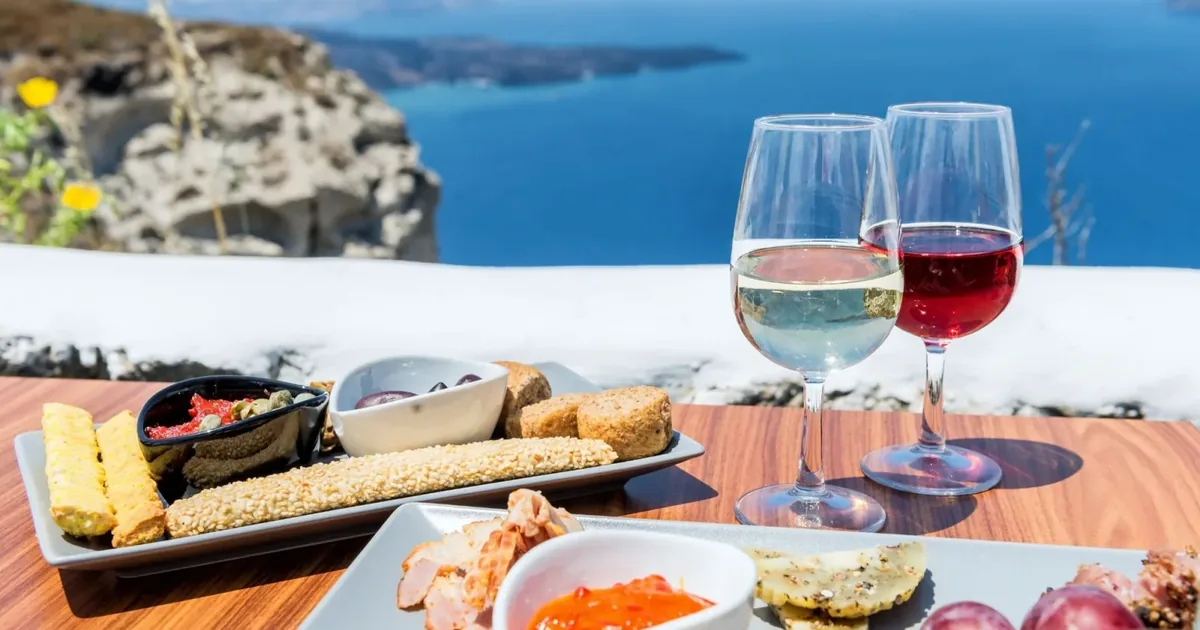
Both facts are true at once, and which one dominates your visit is almost entirely a question of what time you arrive.
Check Availability
Santo Wines at a glance
| Location | Pyrgos, Santorini |
| Best for | First-time visitors, caldera views, Assyrtiko, sunset tastings |
| Wine tasting | Yes |
| Winery tour | Yes |
| Restaurant | Yes |
| Signature wines to try | Assyrtiko, Nykteri, Vinsanto |
| Booking | Strongly recommended for sunset and organised experiences |
| Time to allow | Around 1.5–2 hours for a relaxed tasting; longer with food or a winery tour |
| Best time to visit | Earlier in the day for a calmer tasting; late afternoon for the view and sunset atmosphere |
Short version: Santo Wines is worth visiting for the combination of serious Santorini wine and one of the island’s most impressive winery views. Go earlier if the wine matters more than the sunset; reserve ahead if the sunset is the reason you are going.
What is Santo Wines?
Santo Wines is not a small family winery. It is the wine-producing arm of the Union of Santorini Cooperatives, an organisation whose roots go back to 1911 and which today represents around 1,200 active growers on the island.
That gives it a different role from Santorini’s boutique estates. It works with grapes grown across the island and is tied to the wider agricultural community rather than to a single vineyard or family property.
The current winery at Pyrgos was completed in the early 1990s. Its terraced design follows the slope of the landscape and opens onto the caldera, which is why the location has become almost as famous as the wine.
For a first visit to Santorini’s wine scene, that scale is genuinely useful. You can taste several styles of Assyrtiko, compare young and aged wines, try Nykteri and finish with Vinsanto without planning several separate winery visits.
Is Santo Wines worth visiting?
For most first-time wine visitors, yes.
The strongest reason to go is that Santo Wines combines three things particularly well:
- A broad introduction to Santorini wine
- An unusually dramatic caldera setting
- A visitor-friendly tasting experience
The trade-off is popularity. Santo Wines receives large numbers of visitors and can feel busy, especially late in the day and during the main summer season.
Santo Wines is a good choice if you:
- are visiting Santorini for the first time;
- want to understand Assyrtiko without getting too technical;
- would like to try several styles of local wine in one place;
- want a winery with a caldera view;
- are travelling with someone who cares as much about the setting as the wine;
- want an easy winery visit that can include tasting, food and a short tour.
You may prefer another winery if you:
- are specifically looking for a tiny, family-run cellar;
- dislike busy tasting rooms;
- want a highly personal tasting with the winemaker;
- have already visited several Santorini wineries and want something more specialist.
If you have time for more than one winery, Santo Wines works especially well as one stop on a broader route. The Small-Group Sunset Wine Tour with Santo Winery (4.92 stars, 886 reviews, from $209) is built exactly that way — Sigalas or Argyros first, then Gaia, and Santo last for the light. Our full breakdown of that tour covers what the twelve pours actually are.
Wine tasting at Santo Wines: what to expect
Santo Wines offers organised wine flights as well as the option to explore different wines from its range. The focus is naturally on wines grown in Santorini’s volcanic environment, with Assyrtiko at the centre.
You do not need to know anything about wine to enjoy the tasting. The most useful approach is to choose a flight that lets you compare different Santorini styles rather than ordering several similar dry whites.
A good progression is:
fresh Assyrtiko → richer or oak-aged Assyrtiko → Nykteri → Vinsanto
That gives you a much clearer sense of what the island produces from a relatively small group of native grapes. Our guide to Assyrtiko explains what changes between those glasses and why.
Santo Wines also keeps a Vinotheque collection of older and rarer vintages. That is more interesting for returning visitors, or for anyone who already knows they like Assyrtiko and wants to see how it develops with age.
How much does wine tasting at Santo Wines cost?
Prices change by season and by the tasting you choose, so check the winery’s own booking page before you go.
As a 2026 planning guide, current published visitor information puts standard tasting flights at roughly €18–€55 per person, depending on the number and type of wines. Premium and older-vintage tastings sit towards the upper end.
A short winery tour has also been listed at around €12 per person, including two wine samples.
Treat those figures as a budget guide rather than a fixed price list. Santo Wines lets visitors choose between different wine experiences, and food or additional wines push the final cost up.
Is Santo Wines expensive?
Compared with ordering a glass of wine in a local bar, yes. Compared with organised wine tourism elsewhere on Santorini, the entry-level tasting options are relatively accessible — a full guided tour of three cellars starts around $145 and runs past $200 for the sunset slot, which our Santorini wine tour prices guide breaks down bracket by bracket.
The bigger question is what you want from the visit. At Santo Wines, part of what you are paying for is the location. A sunset table overlooking the caldera is a different proposition from a basic cellar tasting.
If your priority is trying as much wine as possible for the lowest price, compare the tasting options before booking. If the view is the point, the premium over a simple tasting may feel worthwhile.
Which wines should you try at Santo Wines?
Santorini Assyrtiko
If you try only one wine, make it Assyrtiko.
Assyrtiko is Santorini’s defining grape: naturally high in acidity and particularly well suited to the island’s dry, volcanic conditions. Santo Wines produces it in several styles, from fresh unoaked versions to richer wines with extended lees ageing or oak.
The standard Santorini Assyrtiko is the easiest place to start. Expect a dry wine with citrus, mineral and saline notes rather than a soft, fruity white.
If you normally enjoy crisp Sauvignon Blanc, Chablis or dry Riesling, Assyrtiko is likely to be the most immediately appealing Santorini style.
Santorini Nykteri
Nykteri is another traditional Santorini style, and it is worth tasting alongside a straightforward Assyrtiko rather than instead of one.
Santo Wines’ Nykteri is based predominantly on Assyrtiko, with Athiri and Aidani in the blend, and spends time in oak. It is still dry, but broader and more structured than a fresh Assyrtiko.
If you are doing a tasting rather than having one glass, comparing the two is far more interesting than ordering two similar whites.
Assyrtiko Grande Reserve and aged wines
Visitors who already know they like Assyrtiko should look for one of the more developed expressions.
Santo Wines produces oak-aged and reserve versions that show how the grape changes with maturation. Instead of lemon and salinity alone, these wines can develop richer herbal, nutty, honeyed and toasted notes.
They are not the best wines for an Assyrtiko beginner, but they are among the most useful to include if you want a deeper tasting.
Vinsanto
Do not leave without tasting Vinsanto if it is in your flight.
Santorini Vinsanto is a naturally sweet wine made from sun-dried grapes. Santo Wines’ standard bottling is primarily Assyrtiko with Aidani, aged in oak before further bottle ageing.
The style is rich and concentrated, full of dried fruit and spice, but Santorini’s natural acidity keeps it from tasting simply sugary.
Santo Wines also produces much older Vinsanto releases. They are considerably more intense, and they can be the most memorable part of a premium tasting.
Is Santo Wines good for sunset?
Yes — the view is one of the main reasons people visit.
The tasting terraces face across the caldera towards the volcanic islands, giving you a broad western outlook as the sun drops. Unlike the viewpoints in Oia, you can sit down with wine and food rather than standing in a crowded lane waiting for it.
That does not mean Santo Wines is quiet at this hour. Sunset is exactly when demand is highest.
Sunset or daytime: which is better?
Choose sunset if:
- the view is a major part of the experience;
- you are celebrating something;
- photography matters to you;
- you are happy with a livelier atmosphere.
Choose late morning or early afternoon if:
- you care more about the wine than the sunset;
- you prefer a calmer tasting;
- you want more time to ask questions;
- you are visiting in July or August and would rather avoid peak demand.
For many wine-focused visitors, the best compromise is to taste earlier in the day and watch the sunset elsewhere. If you would rather not choose, the Wine Tasting Tour with Snacks (4.97 stars, 753 reviews, from $197) runs the same three-cellar route in both a morning and a sunset version, ending at Santo either way — so you can book the hour rather than the itinerary. Our breakdown of that tour sets out both routes.
For couples or first-time visitors who want one classic Santorini wine experience, sunset at Santo Wines is hard to beat.
Do you need to book Santo Wines in advance?
Booking ahead is the sensible option, particularly if you want:
- a sunset time slot;
- a winery tour;
- a restaurant reservation;
- a specific tasting experience;
- to visit during July, August or another busy period.
The winery runs an online reservation system for its tasting experiences and restaurant.
If your schedule is flexible and you are visiting outside peak periods, an unplanned visit may still work. But travelling across the island specifically for sunset without a reservation is a gamble worth avoiding.
Santo Wines winery tour: is it worth adding?
The winery tour and the wine tasting are separate parts of the experience.
The tour gives you more context about how Santorini wine is produced and how the Pyrgos facility works. Santo Wines recommends doing the winery tour before the tasting, which makes sense: the wines are easier to understand once you have some grounding in the island’s grapes and production methods.
It is particularly worthwhile if Santo Wines is your only winery visit on Santorini.
If you are already taking a guided wine tour, though, you will usually get more detailed vineyard and winemaking explanation from your guide across several cellars. In that case, spend your time at Santo tasting rather than adding another short tour.
Eating at Santo Wines
Santo Wines has a restaurant overlooking the caldera, with Mediterranean dishes and a focus on local ingredients and wine pairing.
That changes the visit considerably. Instead of a 60–90 minute tasting stop, it becomes a longer late-afternoon or evening experience.
The restaurant currently operates daily into the evening, but opening times change, so check the current schedule when you reserve.
For a wine-focused visit you do not need a full meal. Food alongside a tasting still helps if you are sampling several wines, especially the stronger and sweeter styles. If eating properly is the point, the Tour of Wineries with Wine Tasting & Food (4.98 stars, 346 reviews, from $174) builds a real lunch or dinner into a three-cellar route, and the food and wine tours page compares the formats.
Where is Santo Wines?
Santo Wines is in Pyrgos, in the central part of Santorini, roughly south of Fira and above the port area.
The location is convenient because it is not tucked inside the narrow pedestrian centres of Fira or Oia. Visitors arriving by rental car can reach it directly, and many organised wine tours include hotel pickup and transport between wineries.
Do not confuse the main Santo Wines Wine Tourism Center in Pyrgos with Santo 1911 in Vlychada, a newer Santo venue in the south of the island. If your plan is the famous caldera-view tasting, you want the Pyrgos winery.
How to get to Santo Wines
By organised wine tour
This is the easiest option if you want to visit several wineries.
A guided tour removes the main inconvenience of independent wine tasting: somebody has to drive. Tours also make more sense if you want to understand the differences between producers rather than see one estate. Compare every Santorini wine tour we rate if you want Santo Wines to be part of a half-day wine itinerary.
By rental car
Driving is straightforward compared with reaching wineries hidden inside village lanes, and the winery is set up for significant visitor numbers.
The obvious disadvantage is alcohol. Greece’s drink-drive limit is 0.05% BAC, so if you are driving, one person is tasting and spitting while everyone else drinks. Plan the day accordingly.
By taxi or private transfer
A taxi works well if Santo Wines is your only winery stop, but arrange your return rather than assuming a car will be waiting after sunset.
For couples, a taxi may be simpler than paying for a full private tour. For a small group visiting several wineries, a private wine tour is usually better value — the Guided Wineries Private Tour with Wine Tastings (4.99 stars from 43 reviews, a thin but consistent record, from $197) is quoted per vehicle rather than per head.
By bus
Public transport can work depending on the seasonal timetable and route, but Santorini’s buses are built around the Fira hub rather than around winery-hopping.
If you are relying on buses, check the current KTEL timetable on the day rather than building a tight tasting schedule around older information online.
Santo Wines independently or as part of a wine tour?
Both work, but they suit different travellers.
Visit independently if:
- Santo Wines is the only winery you really want to see;
- you want a long, relaxed tasting or dinner;
- you are mainly going for sunset;
- you already know something about Santorini wine and do not need much explanation.
Take a wine tour if:
- you want to visit two or three wineries;
- nobody in your group wants to be the designated driver;
- you want someone to explain Santorini’s vineyards, grapes and winemaking;
- you want to compare Santo Wines with smaller estates;
- you have limited time and want the logistics handled.
For a first wine day on Santorini, the second option usually wins. Santo Wines makes more sense when you can set it beside at least one smaller winery rather than treating it as representative of every producer on the island. The which tour is right for you guide sorts the catalogue by who you are travelling with.
How long should you spend at Santo Wines?
Allow around 1.5 to 2 hours for an unhurried tasting.
You can spend less if you want a small flight and the view, but rushing defeats the point. If you add the winery tour or a meal, plan for longer.
At sunset, give yourself extra time. The best part of the experience is the gradual change in the light, not arriving five minutes before the sun disappears.
Best time of year to visit
Santorini’s main tourist season runs through the warmer months, and winery visits are busiest in summer.
April–May
A good period for wine tourism: the island is active, but generally less intense than midsummer.
June–August
Expect the highest visitor numbers and the strongest demand for sunset reservations. Book ahead.
September–October
One of the most interesting times for wine travellers. The island is still lively, temperatures are pleasant, and the period around harvest gives the vineyards extra relevance.
Winter
The Santo Wines tourism centre operates year-round, which makes it one of the easier wine destinations to consider outside the main season. Services and schedules still differ from summer, so confirm what is running before making a special trip. Our best time for a Santorini wine tour guide goes month by month.
What to combine with Santo Wines
Because the winery is near Pyrgos, it fits easily into a day focused on central and southern Santorini.
Pyrgos village
Pyrgos is worth visiting in its own right rather than treating the area purely as a winery stop. The old village climbs towards a hilltop with narrow lanes and wide views over the island.
Another winery
The most useful addition is a contrasting winery. Visit a smaller producer before or after Santo Wines and you will get a much better feel for the diversity of the island’s wine scene — our best wineries in Santorini guide sorts ten of them by what each is good at.
Megalochori
Megalochori is one of Santorini’s prettiest traditional villages and sits close to several wineries, which makes it easy to combine with a wine-focused day.
What to know before you go
- Reserve sunset in advance. It is the most popular time to visit.
- Do not judge Santorini wine by one glass. Compare a fresh Assyrtiko with Nykteri or an aged version.
- Try Vinsanto. It is one of the island’s most distinctive wine styles.
- Allow more time than you think. The view encourages you to stay.
- Think about transport before the tasting. A wine tour, taxi or private driver makes the day much easier.
- Check the latest prices and hours. Tasting options and schedules change.
- Make sure you are booking Pyrgos. Santo also operates Santo 1911 in Vlychada.
Santo Wines: advantages and drawbacks
| Pros | Cons |
|---|---|
| Outstanding caldera views | Can be very busy |
| Excellent introduction to Santorini wine | Less intimate than a small family winery |
| Broad range of Assyrtiko and Vinsanto | Sunset is a peak-demand period |
| Easy to combine tasting, food and a winery tour | The setting can overshadow the wine for some visitors |
| Suitable for first-time wine visitors | Serious enthusiasts may want smaller specialist producers too |
| Open year-round | Booking is advisable for the most desirable times |
Final verdict: should you visit Santo Wines?
Santo Wines deserves its popularity, but the timing of your visit makes a big difference.
Go at sunset and you are choosing one of Santorini’s classic wine-and-view experiences. It is beautiful, social and understandably popular.
Go earlier and Santo Wines becomes a more useful wine stop: you can pay closer attention to the differences between Assyrtiko, Nykteri, reserve wines and Vinsanto without the late-afternoon rush.
If you have only one winery visit available, Santo Wines is an easy choice because it offers so much in one place. If you have half a day, it is better still as one stop on a wine tour, paired with one or two smaller wineries.
Frequently Asked Questions
Is Santo Wines the same as Santo Winery?
Yes. Travellers search for Santo Winery, Santo Wines Winery or even Santos Winery, but the official name and branding is SantoWines / Santo Wines.
Where is Santo Wines in Santorini?
The main Santo Wines winery and wine tourism centre is in Pyrgos, Santorini, overlooking the caldera. It is roughly south of Fira and above the port area, reachable directly by car rather than through pedestrian village lanes.
Can you visit Santo Wines without a tour?
Yes. You can visit Santo Wines specifically for wine tasting or food rather than joining a multi-winery tour. Booking ahead is still recommended for popular times.
Do you need a reservation for Santo Wines?
It is best to reserve if you want sunset, a winery tour, the restaurant or a particular tasting. Off-peak visits can be more flexible, but crossing the island for sunset without a booking is a gamble.
How much is wine tasting at Santo Wines?
As a 2026 guide, published tasting prices are roughly €18–€55 per person depending on the flight and the wines selected, with a short winery tour listed at around €12 including two samples. Prices change, so confirm the current options before visiting.
What wine is Santo Wines known for?
Assyrtiko is the key wine to try. Santo Wines also produces Nykteri, several aged Assyrtiko styles and Vinsanto, Santorini’s sun-dried sweet wine.
Is Santo Wines good for sunset?
Yes. Its caldera-facing terraces are one of the major reasons the winery is so popular, and unlike the viewpoints in Oia you can sit down with wine and food. Sunset is also the busiest period, so reserve ahead.
Is Santo Wines suitable for people who are not wine experts?
Yes. It is one of the easiest Santorini wineries for beginners, because you can choose structured flights and compare several local wine styles without needing specialist knowledge.
Is there food at Santo Wines?
Yes. Santo Wines has an on-site restaurant focused on Mediterranean food, local products and wine pairings, open daily into the evening in season.
How long do you need at Santo Wines?
Around 1.5–2 hours is comfortable for a tasting. Allow longer if you add a winery tour, dinner, or want to stay through sunset.
Taste Santorini's Volcanic Wines at Three Wineries
Assyrtiko, Nykteri and Vinsanto poured where they are grown, on ash that has never seen phylloxera — finishing at the caldera rim for sunset. Hotel pickup and free cancellation included.
Check Availability & Book