Santorini Vineyards and Volcanic Wine
Why Santorini's vines grow in baskets, how old they are, and what volcanic soil does and does not do to the wine — plus where to see the vineyards up close.
Santorini’s vineyards do not look like the vineyards most travellers expect. There are no long green rows climbing over rolling hills. The vines sit close to the ground in dry, pale volcanic soil, many of them twisted into low circular baskets, and in summer the whole landscape can look almost barren.
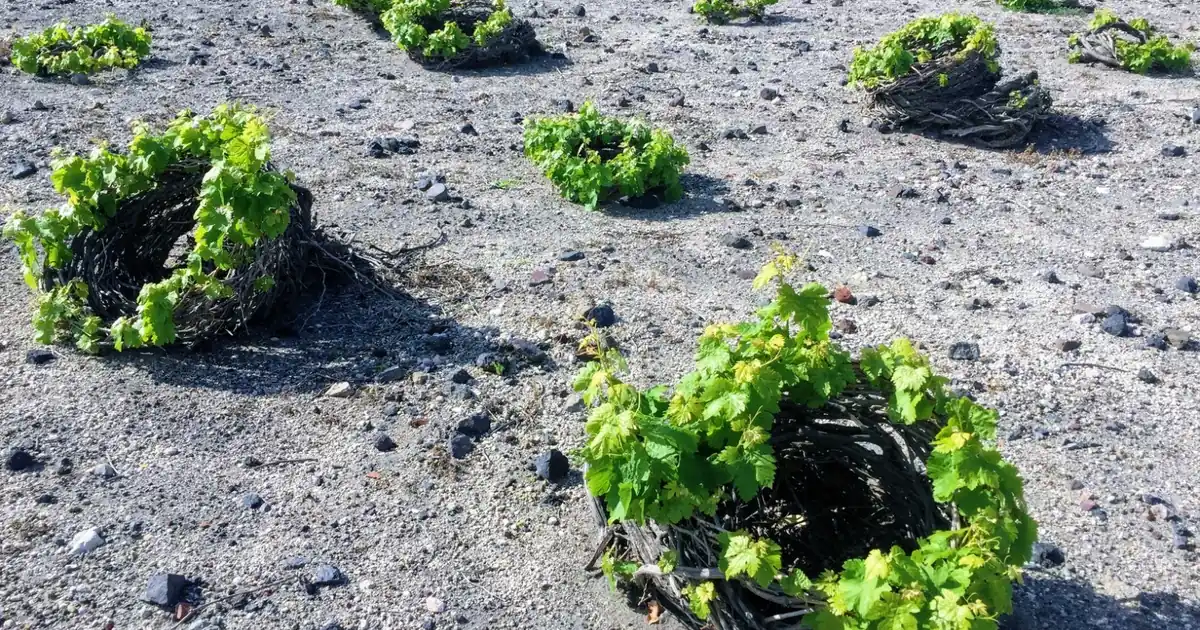
Yet this difficult ground produces some of Greece’s most distinctive wines. Santorini is the historic home of Assyrtiko, a white grape that keeps remarkable acidity in a hot, dry climate. The island also has very old, ungrafted vines, tiny yields, fierce winds and soils formed from volcanic ash, pumice, sand and other volcanic material. All of that matters.
Check Availability
“Volcanic wine” is also a phrase that turns into vague marketing language very quickly. A vine does not soak up the taste of volcanic rock through its roots and pass it into the glass. So what makes Santorini’s vineyards different, and how much of it can you notice in the glass?
Santorini vineyards at a glance
| Main grape | Assyrtiko |
| Other important grapes | Aidani, Athiri, Mavrotragano and several rarer local varieties |
| Soils | Volcanic ash, pumice, sand, basalt, andesite and other volcanic material |
| Climate | Hot, dry Mediterranean climate with strong winds |
| Traditional vine training | Kouloura — low, basket-shaped vines |
| Irrigation | Traditionally dry-farmed |
| Vineyard yields | Extremely low |
| Phylloxera | Historically absent from the island’s sandy volcanic vineyard soils |
| Typical dry wine | Assyrtiko-led PDO Santorini |
| Traditional styles | Santorini, Nykteri and Vinsanto |
| Best way to understand the vineyards | Visit a winery that includes a vineyard walk, or take a guided wine tour |
The short explanation: Santorini wine is distinctive because several extreme factors work together — sandy volcanic soils, drought, wind, old vines, low yields, indigenous grapes and the unusual kouloura training system. No single factor explains the wine on its own.
Why are Santorini’s vineyards so unusual?
Santorini is a difficult place to grow almost anything. The island has:
- very low rainfall;
- intense summer sun;
- strong Aegean winds;
- poor volcanic soils;
- limited fresh water;
- very little organic matter;
- steep or uneven terrain in places.
Conventional upright training would leave the grapes exposed to the wind and the sun, irrigation is limited, and vigorous growth is hard to come by. Generations of growers adapted to the landscape instead of forcing a conventional vineyard onto it, and the result is one of Europe’s most recognisable viticultural systems.
The vines are kept low and many are woven into baskets. Farming is largely manual and yields are tiny. A vineyard that looks sparse from the road can hold exceptionally old root systems beneath the soil.
What is Santorini’s volcanic soil made of?
Santorini’s soils were shaped by repeated eruptions. They contain varying mixtures of:
- volcanic ash;
- pumice;
- sand;
- lava-derived material;
- basalt;
- andesite;
- other volcanic rocks.
The mix is not the same across the island, which is why “volcanic soil” is best read as an umbrella term and not as one uniform soil type. Some vineyards hold more pumice, others are sandier, and each site has its own depth, exposure and proportion of volcanic material.
What they generally share is low fertility and very little clay — and that has had major consequences for the vines.
Does volcanic soil make wine taste mineral?
This is where wine language can mislead. People often describe Santorini Assyrtiko as:
- mineral;
- flinty;
- smoky;
- stony;
- saline.
Those are perfectly reasonable tasting descriptions. What is too simple is the idea that volcanic rock dissolves into the vine and then makes the wine “taste like minerals”.
A wine’s flavour comes from a complicated interaction of:
- grape variety;
- water availability;
- soil structure;
- soil chemistry;
- climate;
- sunlight;
- wind;
- vine age;
- yield;
- fermentation;
- ageing;
- winemaking choices.
The volcanic soil matters enormously because it changes how the vine grows, above all its access to water, its vigour and the conditions around its roots. What you taste in the finished wine is the result of that whole system.
So when a winery tells you its wine tastes “volcanic”, read it as shorthand for a distinctive terroir. It is not a literal transfer of rock flavour into the grape.
Why does Santorini have ungrafted vines?
One of the most striking things about Santorini is that many of its vines grow on their own roots.
In the 19th century most European vineyards were devastated by phylloxera, a tiny insect that attacks vine roots. The long-term solution was to graft European grape varieties onto resistant American rootstock, and that is still how most vines in Europe are grown today.
Santorini is different. Its sandy, low-clay volcanic soils have historically been inhospitable to phylloxera, so the island’s vineyards escaped the destruction seen across most of Europe. Many Santorini vines are therefore ungrafted, growing on their original roots.
That does not mean every visible branch is hundreds of years old. The way Santorini vines are renewed makes the story more interesting than that.
How old are Santorini’s vines?
You will often hear claims of vines that are 100, 200 or even 300 years old. The distinction that matters is between the root system and the vine wood you can see.
Santorini growers traditionally renew an ageing basket by letting a new shoot take over while keeping the established root system below ground. A vineyard can therefore hold very old roots even though the growth above ground has been renewed several times.
Wines of Greece describes Santorini as one of the world’s oldest continuously cultivated vineyard landscapes, with some basket-trained vines sitting on root systems said to reach around 300 years. That is remarkable, but do not assume every bottle labelled Santorini comes from 300-year-old vines. Vine age varies enormously by parcel and producer.
When a winery makes a specific old-vine claim, the useful question is: how old are the vines in this particular vineyard?
What is a kouloura?
The kouloura is Santorini’s famous basket-shaped vine-training system. Instead of training the shoots upward onto wires, growers weave them round into a low circular form close to the ground, and the grapes develop inside the basket.
From a distance, a vineyard can look like a field of low, tangled shrubs. There is a very practical reason for the shape.
Why are Santorini vines grown in baskets?
The kouloura protects the grapes from Santorini’s harsh conditions.
Protection from wind
Strong northerly meltemi winds can sweep across the island during the growing season. An upright vine would be far more exposed. Keeping the plant close to the ground, with the grapes inside the woven basket, gives the fruit shelter.
Protection from intense sunlight
Santorini gets powerful summer sun. The basket shades the fruit and cuts down its direct exposure.
Protection from blowing material
Strong winds carry sand and dust, and the low basket helps shield delicate grape skins from abrasion.
Adaptation to water scarcity
The low-growing system is part of a broader dry-farming tradition on an island with little rain. The vines stay close to the soil and never support a large canopy high above it.
The result is not picturesque in the conventional sense. Once you understand the pressure the environment puts on a vine, though, the strange-looking baskets become one of the most logical things about farming on Santorini.
What is koulouraki?
You may also hear the term koulouraki. Wines of Greece identifies two traditional low training systems on Santorini:
- kouloura — the characteristic basket;
- koulouraki — a smaller, low goblet-like form.
Both exist because high training copes badly with the island’s wind. For most visitors, the basket-shaped kouloura is the one that sticks in the memory and the easiest to recognise.
How do Santorini vines survive without much rain?
Rainfall is extremely limited, particularly during the growing season, and Santorini’s vineyards are traditionally dry-farmed: they are not routinely irrigated.
The vines get by partly through deep, established root systems, and partly because the island’s porous volcanic materials interact with humidity, dew and the occasional rainfall. Night-time humidity and sea mist can add moisture where direct rain is scarce.
That does not mean a vine is literally “watered by fog”, the way an irrigated vineyard is watered through pipes. It means the whole vineyard system has adapted to very little available moisture — and that water stress is one of the reasons yields are so low.
How low are vineyard yields in Santorini?
Very low. Wines of Greece notes that although the regulations permit substantially larger yields, normal Santorini yields can sit around 20 hectolitres per hectare, and difficult years can drop below 10 hl/ha. Those figures are tiny next to many commercial wine regions.
Low yields come from several factors:
- old vines;
- drought;
- poor soil;
- wind;
- naturally small crops;
- manual farming;
- difficult growing conditions.
Low yield alone does not guarantee great wine. When healthy grapes do ripen, though, there is relatively little fruit per vine, which can add concentration. It also makes Santorini wine expensive to produce.
Why is Santorini wine relatively expensive?
Visitors sometimes see a €30 or €40 bottle of Assyrtiko, or a much dearer one, and assume the price is mostly Santorini’s tourism premium. Tourism certainly pushes up land values and running costs, but growing grapes here is expensive in its own right.
Low yields
Growers harvest far fewer grapes per hectare than in many wine regions.
Manual vineyard work
A kouloura cannot be managed like a mechanised vineyard with long straight rows. Much of the pruning, training and harvesting is done by hand.
Old vineyards
Old vines often produce less fruit.
Limited vineyard area
Santorini is small, and its vineyards compete directly with hotels, villas and other tourism development for land.
Growing demand
Assyrtiko has become internationally recognised, which increases demand for a limited amount of fruit.
Put low production together with expensive labour and scarce land, and premium pricing becomes easier to understand.
What is dry farming?
Dry farming means growing crops without routine artificial irrigation. Santorini’s traditional vineyards rely on natural moisture instead of a regular supply of irrigation water.
Santo Wines describes this as a defining feature not only of the vineyards but also of the island’s other famous crops, such as Santorini tomatoes and fava.
Dry farming limits both growth and productivity. In a wet, fertile region a vine can put out abundant leaves and fruit; Santorini forces the opposite strategy — survive first, crop second. That is one reason the landscape looks so sparse.
What grapes grow in Santorini?
Assyrtiko dominates the conversation, but Santorini has several indigenous grapes you will meet on a tasting.
Assyrtiko
The star of the island. Assyrtiko keeps striking acidity despite the hot climate and makes dry wines with citrus, structure and often a saline or savoury character.
Under the current PDO Santorini rules, dry PDO wines contain at least 85% Assyrtiko, with Athiri and Aidani permitted in the blend. Many producers make their Santorini from 100% Assyrtiko.
Read our full guide to Assyrtiko wine.
Aidani
A white grape that is generally softer and more aromatic than Assyrtiko. It appears in dry wines and in sweet Vinsanto blends, and some producers also bottle it on its own.
Athiri
Another traditional white grape permitted in PDO Santorini blends. It can soften or broaden an Assyrtiko-led wine.
Mavrotragano
One of Santorini’s most interesting red grapes. Mavrotragano was once used largely for blending, and it is increasingly treated as a serious dry red variety in its own right. Good versions show dark fruit, spice and firm structure.
If you spend a day visiting wineries, include at least one Mavrotragano. It stops the tasting becoming six white wines in a row.
Rare local varieties
Several producers are working to preserve less common island grapes. Depending on the winery, you may come across:
- Katsano;
- Gaidouria;
- Voudomato;
- Platani;
- Potamisi.
These are made in much smaller volumes than Assyrtiko. For curious wine travellers they can be the most interesting bottles on the island, because they are hard to taste anywhere else.
What does Santorini volcanic wine taste like?
There is no single “volcanic wine flavour”. Still, dry Santorini Assyrtiko often shares a recognisable profile. Expect some combination of:
- lemon;
- grapefruit;
- citrus peel;
- stone fruit;
- herbs;
- a salty or saline sensation;
- smoke or flint-like notes;
- high acidity;
- firm texture.
Young wines can feel almost austere. With lees ageing, oak or time in bottle they broaden and can show:
- honey;
- nuts;
- wax;
- dried herbs;
- preserved lemon;
- toast;
- spice.
The best way to understand the style is to taste two or three Assyrtikos side by side. One bottle tells you whether you like that bottle. Several producers tell you something about Santorini.
Is all Santorini wine volcanic wine?
Geographically, wines grown on Santorini’s volcanic soils can reasonably be called volcanic wines. But the phrase is not a formal wine category in the way that PDO Santorini is.
“Volcanic wine” is used internationally for wines from many volcanic regions, including:
- Santorini;
- Etna;
- the Canary Islands;
- the Azores;
- Campania;
- parts of Hungary and elsewhere.
Those wines can differ completely in colour, grape, climate and taste. Do not assume that liking Etna Rosso tells you whether you will like Santorini Assyrtiko. What connects them is geology, not one standard flavour.
What does PDO Santorini mean?
PDO stands for Protected Designation of Origin. It defines where the grapes come from and how qualifying wines must be made.
For dry PDO Santorini today, Assyrtiko must make up at least 85% of the wine, with Athiri and Aidani allowed in the remainder. The appellation also covers the traditional styles Nykteri and Vinsanto.
PDO matters because “Assyrtiko” and “Santorini” are not the same thing. Assyrtiko can be grown elsewhere in Greece; a PDO Santorini wine has to come from the protected Santorini production zone and meet its rules.
What is Nykteri?
Nykteri is a traditional dry Santorini style. Under the modern PDO rules it is a higher-alcohol dry Santorini wine that spends at least three months in oak.
Historically, the name is linked to night-time winemaking after the harvest — it comes from the Greek word for night. The style is usually richer and more powerful than a simple young Assyrtiko, and if a winery offers both its standard Santorini and a Nykteri, taste them side by side.
What is Vinsanto?
Vinsanto is Santorini’s traditional sweet wine. The grapes are left in the sun after harvest to dehydrate, which concentrates both sugar and acidity, and the wine then goes through long oxidative ageing.
The result is sweet, dark and intensely flavoured, often with:
- raisins;
- dried apricot;
- fig;
- caramel;
- coffee;
- nuts;
- orange peel;
- spice.
It may seem to have nothing in common with a young Assyrtiko, but Assyrtiko is normally the dominant grape.
Read our full guide to Vinsanto wine.
Are Santorini vineyards beautiful?
Yes — though not in the conventional postcard way. If you expect lush green rows against the sea, the first sight may surprise you. The beauty is in how strange the landscape is:
- black and pale volcanic earth;
- low baskets of vines;
- dry-stone terraces;
- white villages in the distance;
- the Aegean all around.
Spring and early summer are greener; later in the season the landscape dries out considerably.
A vineyard visit pays off for exactly this reason: without an explanation, it is easy to drive across Santorini without realising how unusual the fields beside the road are.
Where are the vineyards in Santorini?
Vineyards are scattered across much of the island, not gathered into a single “wine valley”. Important wine-growing and winery areas include:
- Pyrgos;
- Megalochori;
- Exo Gonia;
- Episkopi Gonia;
- Vourvoulos;
- the areas around Akrotiri;
- the north of the island, around Oia and Baxes.
Thirasia, across the caldera, is also part of the PDO Santorini zone.
For visitors, the centre and south of the main island are especially convenient, because several wineries can be combined without long transfers.
Best Santorini vineyards and wineries to visit
If the vineyard itself interests you, pick a winery experience that explains how the grapes are grown, not one that only pours wine on a terrace.
Estate Argyros — best for vineyard education
Estate Argyros is a strong first choice for understanding old vines and Assyrtiko. Its wine-tourism experiences focus on Santorini’s vineyard conditions, not just a flight at a bar.
It helps to go early in your trip, because afterwards you will recognise kouloura vines all over the island. The Three Wineries and One Brewery Tour (4.85 stars, 249 reviews, from $197) names Argyros Estate as a fixed stop.
Domaine Sigalas — best near Oia
Domaine Sigalas sits in the Baxes area near Oia and gives visitors more of a vineyard setting than the cliff-side tasting rooms elsewhere. It is especially useful if you are staying in the north of the island and want to taste several expressions of Assyrtiko without crossing Santorini.
Gavalas — best for traditional wine culture
In Megalochori, Gavalas pairs a historic family winery with a strong focus on native grapes. It is a good place to explore varieties beyond Assyrtiko and to see how the island’s wine tradition reaches past its most famous grape.
Santo Wines — best for first-time visitors and views
Santo Wines is not the most intimate vineyard experience, but it is an excellent broad introduction to the island’s wine. As the cooperative representing growers across Santorini, it also gives useful context on the island’s farming economy. The caldera view is a bonus, and often the reason travellers choose it.
The Small-Group Sunset Wine Tour with Santo Winery (4.92 stars, 891 reviews, from $209) finishes on its terrace, after tastings at Argyros Estate, Sigalas or Gaia — which of those you get depends on the day.
Read our Santo Wines guide. For a broader comparison, see the best wineries in Santorini.
Should you take a Santorini vineyard tour?
If you want to know why the wines taste different, yes. A normal tasting tells you what is in the glass. A good vineyard tour explains:
- why the vines are shaped like baskets;
- why irrigation is limited;
- how old vines are maintained;
- what volcanic soil means in practice;
- why yields are tiny;
- how Assyrtiko adapts to heat;
- why vineyard land is under pressure.
Those details make the tasting afterwards far more meaningful.
Several tours build the vineyard in. The Wine Tasting Tour with Snacks (4.97 stars, 753 reviews, from $197) starts at a vineyard on black volcanic soil and walks you through the basket vines before three cellars (our breakdown). The Guided Tour to 3 Wineries with Wine Tastings (4.78 stars, 725 reviews, from $174) also opens at a basket-vine vineyard (our breakdown), and Santorini Wine Roads (4.84 stars, 79 reviews, from $209) is sommelier-led and pulls over at a vineyard to show how the kouloura is trained.
Vineyard tour vs winery tasting
Choose a simple winery tasting if:
- you mainly want to try local wine;
- you are short on time;
- you already understand Santorini viticulture;
- the view or the food matters more than technical detail.
Choose a vineyard-focused tour if:
- this is your first serious introduction to Santorini wine;
- you are interested in Assyrtiko;
- you want to see kouloura vines up close;
- you want to compare several producers;
- you enjoy learning how landscape shapes wine.
Browse every Santorini wine tour we rate if you want transport and several winery visits combined.
Can you visit Santorini vineyards without drinking?
Yes. Even if you drink very little, the vineyard landscape repays the visit. A winery tour can still be interesting for:
- agriculture;
- geology;
- history;
- food culture;
- photography.
If you do not drink alcohol, check before booking whether the winery offers a non-alcoholic alternative or a cheaper tour-only option. Some experiences are priced around the tasting itself, and policies vary.
When is the best time to see Santorini vineyards?
What changes through the year is the vine itself, and the answer depends on what you want to see in the field. Tour availability is a separate question: most wine tours run daily from May to October and thin out or stop outside that window, which our best time guide covers month by month.
April and May
The vines are actively growing and the landscape is relatively fresh. This is one of the nicest periods if your priority is the vineyard, not the harvest — though in April fewer tours are running.
June and July
The vines are fuller and the grapes are developing. Days can be very hot; morning vineyard visits are more comfortable.
August
Santorini has one of Europe’s earliest harvests: picking generally begins in the first half of August, far earlier than in northern European wine regions. The exact dates change with the year and the vineyard, so if harvest activity matters to you, ask the winery what is happening that week instead of assuming September is the main harvest month.
September and October
The vineyards quieten after the harvest, while the island itself usually stays excellent for wine tourism. Autumn is a particularly good time for tasting, even with the grapes already in the winery.
Late October to April
The vineyard landscape is much less dramatic in the cooler months, but the structure of the baskets is still easy to see. Some wineries cut their visitor hours, which makes planning ahead more important.
Is Santorini’s vineyard landscape under threat?
Yes, and this is one of the less romantic parts of the story. Santorini has limited land and enormous tourism demand. Its vineyards compete with:
- hotels;
- villas;
- roads;
- visitor infrastructure;
- other development.
At the same time, growing grapes here is hard physical work and yields are low, which puts economic pressure on vineyard owners.
It matters because Santorini’s wine identity depends on preserving not just individual old vines but a working vineyard landscape and the farming community behind it. Buying local wine, visiting producers and choosing serious wine-tourism businesses will not solve the pressure on land by themselves, but they help keep grape growing economically viable.
Common myths about Santorini vineyards
“The vines taste of volcanic rock because their roots absorb minerals”
Too simplistic. Soil affects vine growth, water relations and nutrient availability, but wine flavour cannot be explained as a direct transfer of rock taste into grapes.
“Every Santorini vine is hundreds of years old”
No. Some root systems are exceptionally old, but vineyard ages vary greatly.
“Santorini has no water, so the vines survive only on sea mist”
Also too simple. Humidity, dew, occasional rainfall, porous soils and established roots all contribute to the water a vine can use.
“All Santorini wine is Assyrtiko”
No. Assyrtiko dominates PDO dry wine, but the island also grows Aidani, Athiri, Mavrotragano and several rarer varieties.
“Volcanic wine is a specific wine style”
No. It is an informal label for wines grown in volcanic regions, and those wines can be red, white, sparkling, dry or sweet.
Frequently Asked Questions
Why are Santorini vineyards famous?
They combine volcanic soils, old ungrafted vines, extremely low rainfall, strong winds and the traditional basket-shaped kouloura training system. The island is also the historic home of Assyrtiko.
Why are Santorini vines shaped like baskets?
The kouloura basket protects the grapes from fierce wind, blowing sand and intense sunlight by keeping the fruit low and sheltered inside the vine.
How old are Santorini vines?
Some vineyard root systems are extremely old and may reach centuries in age, but not every vine or vineyard is equally old.
Why did phylloxera not destroy Santorini vineyards?
Santorini’s sandy, low-clay volcanic soils have historically kept phylloxera from establishing itself the way it did across most European vineyards.
Are Santorini vines grafted?
Many traditional vineyards are ungrafted and grow on their own roots, which is unusual in Europe.
What is volcanic wine?
It is an informal term for wine made from grapes grown in volcanic soils or volcanic landscapes. It is not one single flavour or an official wine category.
Does volcanic wine taste like minerals?
Santorini wines are often described as mineral, saline, smoky or flinty, but those flavours should not be read as volcanic minerals moving from the soil into the wine.
What grape is Santorini famous for?
Assyrtiko, a white grape known for high acidity, citrus character, structure and ageing potential.
What other grapes grow in Santorini?
Aidani, Athiri and Mavrotragano are important local varieties, along with several rarer grapes such as Katsano that individual producers are preserving.
What is the best vineyard to visit in Santorini?
Estate Argyros is particularly good for vineyard education. Domaine Sigalas is convenient near Oia, Gavalas is strong on traditional wine culture, and Santo Wines pairs an accessible introduction with caldera views.
Can I walk through vineyards in Santorini?
Only where permitted. Santorini’s vineyards are working farmland, not public parks. Join a vineyard experience, or stay on public roads and paths unless the producer explicitly allows access.
When is the grape harvest in Santorini?
Santorini’s harvest is unusually early: picking generally begins in the first half of August. Exact timing varies by year, grape and vineyard.
Final thoughts
Santorini wine makes much more sense once you have stood beside the vines. The landscape explains why the island does not produce cheap, plentiful wine.
There is almost no excess in the vineyard: little water, little fertile soil, little fruit and very little room for machines. The vines stay close to the ground because the wind demands it. Their roots survive in sandy volcanic soils that helped protect them from phylloxera, and growers work tiny crops by hand. Then Assyrtiko takes those conditions and turns them into a wine that can still feel startlingly fresh.
That is the story behind Santorini’s “volcanic wine”. The volcano matters, but so do the wind, the drought, the vines, the grapes and centuries of human adaptation.
If you are visiting the island, spend at least part of one tasting outside the tasting room. Once you understand the vineyard, the wine in your glass becomes far more interesting. Every Santorini wine tour we rate is compared on vineyard visits, group size, sunset timing and what gets poured.
Taste Santorini's Volcanic Wines at Three Wineries
Assyrtiko, Nykteri and Vinsanto poured where they are grown, on ash that has never seen phylloxera — finishing at the caldera rim for sunset. Hotel pickup and free cancellation included.
Check Availability & Book