Santorini Wine Guide: What to Drink and How to Taste It
Santorini wine explained: Assyrtiko, Nykteri, Vinsanto and the island's other grapes, why the wines taste different, which wineries to visit, and how to plan a tasting.
Santorini is famous for whitewashed villages and caldera sunsets, but its wine culture is much older than its tourism industry. Vines have been grown here for centuries in conditions that look almost impossible for wine: volcanic soils, very little rain, fierce Aegean winds and intense summer sun.
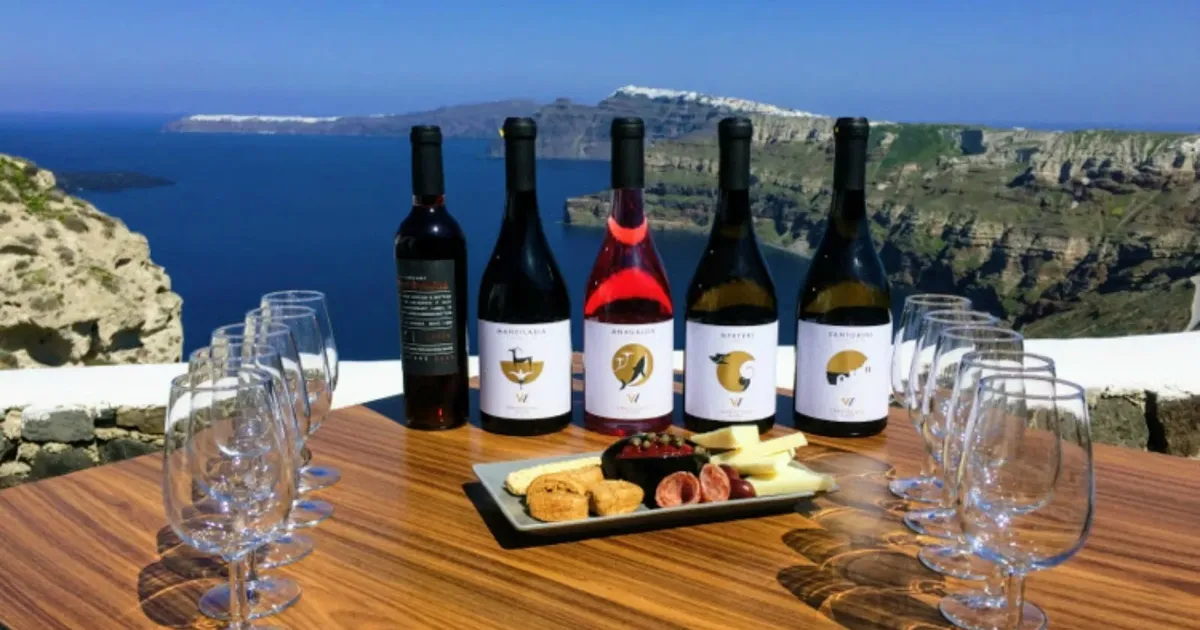
Instead of neat upright rows, many of the vines are trained into low basket shapes called kouloura. The island’s most important grape, Assyrtiko, stays remarkably fresh and acidic despite the heat — and that combination makes wines unlike the easy, fruity whites many travellers expect from a Mediterranean island.
Check Availability
Santorini’s best dry wines can be sharp, saline, smoky, structured and age-worthy. Traditional Nykteri is richer and more powerful. Vinsanto, made from sun-dried grapes, goes the other way: intensely sweet, dark and concentrated, yet still lifted by natural acidity.
You do not need to become a Greek-wine expert before a wine tasting in Santorini. A few grapes and styles are enough, and this guide covers them.
Santorini wine at a glance
| Most important grape | Assyrtiko |
| Main dry style | PDO Santorini dry white |
| Other traditional styles | Nykteri and Vinsanto |
| Other local grapes to know | Aidani, Athiri, Mavrotragano and several rarer indigenous varieties |
| Typical dry-wine profile | Citrus, high acidity, saline/mineral character, herbs, smoke |
| Sweet wine | Vinsanto |
| Vineyard soils | Volcanic ash, pumice, sand and other volcanic material |
| Traditional vine training | Kouloura basket vines |
| Best for first-time visitors | Compare 2–3 wineries instead of drinking one wine at one estate |
| Best tasting order | Young Assyrtiko → aged/barrel Assyrtiko → Nykteri → red indigenous grape → Vinsanto |
If you remember only three names: Assyrtiko is the grape, Nykteri is a richer traditional dry Santorini style, and Vinsanto is the island’s famous sweet wine.
What wine is Santorini famous for?
Santorini is overwhelmingly associated with Assyrtiko, a native Greek white grape that thrives in the island’s dry volcanic landscape. Its defining quality is that it keeps very high acidity even when the grapes ripen under intense Mediterranean sun.
That gives Santorini wine its characteristic tension. The fruit can be ripe, the alcohol substantial and the climate extremely warm, and the wine may still feel almost razor-sharp. Typical flavours include:
- lemon;
- grapefruit;
- citrus peel;
- white or yellow fruit;
- herbs;
- smoke or flint-like notes;
- salt or saline sensations.
The best examples also age well, developing honey, nuts, dried herbs, wax and more savoury complexity.
For most visitors, dry Santorini Assyrtiko should be the first wine you taste on the island.
What does “PDO Santorini” mean?
PDO stands for Protected Designation of Origin: the wine has to come from the defined Santorini production area and follow specific rules.
Under the current PDO rules, dry Santorini wine must contain at least 85% Assyrtiko, with Athiri and Aidani permitted in the remainder. Many producers make their flagship Santorini entirely from Assyrtiko.
The PDO also covers two traditional styles:
- Nykteri
- Vinsanto
The distinction matters because not every bottle labelled Assyrtiko comes from Santorini — the grape is now grown on the Greek mainland and elsewhere. If the label says PDO Santorini, the wine is tied to the island’s protected wine zone.
Assyrtiko: Santorini’s signature grape
If Santorini had one wine identity, it would be Assyrtiko. The grape suits the island’s climate unusually well because it can combine:
- ripe fruit;
- relatively high alcohol;
- very high acidity;
- firm structure;
- ageing potential.
That sets it apart from many simple holiday whites. A young Santorini Assyrtiko can feel almost austere at first, and it is usually more about structure, saltiness and freshness than obvious tropical fruit.
What does Assyrtiko taste like?
Common notes include:
- lemon;
- lime;
- grapefruit;
- citrus peel;
- peach;
- herbs;
- smoke;
- stone or flint-like impressions;
- a saline finish.
Oak-aged or bottle-aged examples can develop:
- honey;
- nuts;
- toast;
- spice;
- wax;
- dried citrus;
- a richer texture.
Is Assyrtiko always dry?
No. Most of the Assyrtiko people meet is dry, but the grape is also central to Vinsanto, Santorini’s traditional sweet wine.
That is why tasting dry Assyrtiko and Vinsanto in the same winery visit is so useful: you see two completely different expressions of the same island and related grapes.
Our full Assyrtiko wine guide goes much deeper.
What is Nykteri?
Nykteri is a traditional dry Santorini wine style. PDO Nykteri today has to meet specific requirements, including a minimum alcohol level and at least three months of oak ageing.
In tasting terms, Nykteri is usually:
- richer;
- broader;
- more powerful;
- more obviously structured than a basic young Santorini white.
It can show:
- ripe citrus;
- stone fruit;
- spice;
- oak;
- nuts;
- herbal notes.
The name is historically linked to night-time winemaking after the harvest. If your tasting includes both a standard Santorini Assyrtiko and a Nykteri, drink the lighter Assyrtiko first; the comparison makes far more sense in that order.
What is Vinsanto?
Vinsanto is Santorini’s traditional naturally sweet wine, made from sun-dried grapes. It should not be confused with Italian Vin Santo.
For Santorini Vinsanto, ripe grapes are harvested and left in the sun to dehydrate. As the water goes, sugar, acidity and flavour concentrate. The juice ferments slowly, and the wine then goes through long oxidative ageing.
Typical flavours include:
- raisins;
- dried apricot;
- figs;
- orange peel;
- honey;
- caramel;
- coffee;
- nuts;
- cinnamon and other spices.
PDO Vinsanto requires at least 24 months of oxidative maturation, and many producers release versions aged far longer. A good Vinsanto is extremely sweet, but Assyrtiko’s acidity keeps it from tasting flat or syrupy.
Our complete Vinsanto wine guide explains the style in more detail.
What other grapes grow in Santorini?
Assyrtiko dominates, but a good Santorini wine tasting should introduce you to more than one grape.
Aidani
A white grape that tends to be softer and more aromatic than Assyrtiko. It can bring:
- floral notes;
- roundness;
- ripe fruit;
- gentler acidity.
Aidani is permitted in PDO Santorini blends and is commonly used alongside Assyrtiko in Vinsanto. Some wineries bottle it on its own, and if you find straight Assyrtiko too severe, a varietal Aidani makes a useful contrast.
Athiri
Another traditional white variety. It can appear in PDO blends alongside Assyrtiko and generally adds softer fruit and delicacy. It is less famous internationally, which makes a winery tasting a good chance to try it.
Mavrotragano
One of the most interesting local red grapes. For many years it played a fairly minor role, and modern producers now make serious dry reds from it. Expect some combination of:
- dark berry fruit;
- spice;
- herbs;
- firm tannin;
- savoury structure.
After several high-acid whites, a glass of Mavrotragano is a welcome change during a long tasting.
Rare local grapes
Some producers still work with tiny quantities of lesser-known Santorini varieties, such as:
- Katsano;
- Gaidouria;
- Voudomato;
- Platani;
- Potamisi.
You are unlikely to find these on a supermarket shelf outside Greece. If a winery includes one in a tasting, try it — this is exactly the kind of wine travel is good for.
Why are Santorini wines so different?
The answer is not just “because of the volcano”. Several extreme conditions shape Santorini wine at once.
Volcanic soils
The island’s vineyard soils contain varying proportions of:
- volcanic ash;
- pumice;
- sand;
- lava-derived rock;
- other volcanic material.
They are poor in organic matter and generally hold little clay.
Very little rain
Santorini is exceptionally dry, and its traditional vineyards are largely dry-farmed instead of regularly irrigated.
Strong winds
Aegean winds can be fierce, especially during the growing season.
Old vines
Because phylloxera historically struggled to establish itself in Santorini’s sandy volcanic soils, many vines are ungrafted and some root systems are exceptionally old.
Tiny yields
Drought, old vines, poor soils and wind together produce very little fruit per hectare compared with many commercial wine regions.
All of this helps explain why Santorini wine can be concentrated, distinctive and expensive. Our guide to Santorini vineyards and volcanic wine tells the full story.
Why are Santorini vines shaped like baskets?
The island’s traditional vine-training system is called kouloura. Instead of training shoots upward on wires, growers weave them into a low circular basket, and the grapes develop inside. This protects them from:
- strong winds;
- blowing sand and dust;
- intense sunlight.
The baskets are maintained by hand, which makes Santorini viticulture extremely labour-intensive. Once you see a kouloura vine up close, much of Santorini wine starts to make sense: the unusual wine begins with an unusual vineyard.
Is Santorini really a “volcanic wine” region?
Yes, with some context. Santorini is one of the world’s best-known volcanic wine regions, but “volcanic wine” is not a formal wine style, and wine does not taste of lava because minerals travel unchanged from rock into the grape.
The volcanic geology matters because it affects:
- soil structure;
- drainage;
- water availability;
- vine vigour;
- the root environment.
That combines with climate, grape variety and farming to shape the finished wine. Words such as saline, flinty, smoky and mineral are useful tasting language, but they are not proof that you are tasting volcanic rock.
Is Santorini wine salty?
Some dry Assyrtiko gives a striking saline impression, which you may notice more as a mouth-watering savoury sensation than as an obvious taste of salt.
Why it happens is more complicated than “the sea gets into the grapes”: the grape variety, climate, acidity, vineyard conditions and winemaking all play a part. Even so, salinity is one of the characteristics most closely associated with good Santorini Assyrtiko.
Is Santorini wine expensive?
Compared with many everyday Greek whites, yes, and for practical reasons.
Very low yields
Santorini vines produce very little fruit.
Manual labour
Basket-trained vines need a great deal of hand work.
Old vineyards
Old vines often crop less heavily.
Limited land
Santorini is small, and vineyard land competes directly with highly profitable tourism development.
Strong global demand
Assyrtiko has become internationally recognised.
There is not enough Santorini wine to make it a cheap mass-market product. For visitors, that makes a tasting good value: you compare several wines without buying full bottles.
What Santorini wine should a beginner try?
If you are new to Greek wine, follow this progression.
1. Young dry Assyrtiko
The clearest introduction to Santorini. Look for acidity, citrus and salinity.
2. Lees-aged or barrel-aged Assyrtiko
Compare the texture: it may feel creamier, broader and more complex.
3. Nykteri
Now move to a more powerful traditional dry style.
4. Mavrotragano
Add a red, so your palate gets a break from high-acid whites.
5. Vinsanto
Finish with the sweet wine.
That sequence teaches you far more about Santorini than five young Assyrtikos in a row.
Best Santorini wines to look for
You do not need to memorise labels, but these categories repay the search.
PDO Santorini Assyrtiko
The essential starting point.
Single-vineyard Assyrtiko
Useful once you know the basic style, because single-vineyard wines show how much the producer and the site matter.
Aged Assyrtiko
One of the biggest surprises for visitors who assume Greek white wine should always be drunk young. Good examples evolve beautifully.
Nykteri
A richer, stronger dry Santorini style.
Mavrotragano
The local red to look out for.
Vinsanto
Try it at least once, even if you usually avoid dessert wine.
Best wineries in Santorini for first-time visitors
Santorini has many good producers, and they offer very different experiences.
Estate Argyros — best for understanding the wine
Estate Argyros is one of the strongest choices if you want to learn why Santorini wine tastes the way it does. Its tastings focus on vineyards, Assyrtiko, native varieties and ageing, which makes it a good first winery: the explanation helps with every tasting after it. The Three Wineries and One Brewery Tour (4.85 stars, 249 reviews, from $197) includes it as a fixed stop.
Santo Wines — best for broad choice and caldera views
Santo Wines is the island’s large cooperative winery and one of its most famous visitor destinations. It offers:
- several Assyrtiko styles;
- Nykteri;
- Vinsanto;
- other local wines;
- winery tours;
- food;
- panoramic caldera views.
It suits first-time visitors who want an easy introduction. The main drawback is its popularity.
Read our full Santo Wines Santorini guide.
Gavalas — best for traditional family-winery atmosphere
Gavalas in Megalochori is a smaller, more intimate contrast, and a good place to discover native grapes beyond Assyrtiko.
Domaine Sigalas — best near Oia
If you are staying in Oia, Domaine Sigalas is the obvious serious winery nearby. Its range lets you explore different expressions of Assyrtiko alongside other indigenous grapes and Vinsanto.
Hatzidakis — best for enthusiasts
Hatzidakis suits travellers who already know they care about wine. The experience is wine-first and appointment-led, with little of the panoramic tourism infrastructure found elsewhere. The Wine Tour with Sunset in Oia (4.48 stars, 221 reviews, from $127) starts its route there.
For a broader comparison, see our guide to the best wineries in Santorini.
Should you visit one winery or several?
One winery is enough if you simply want to taste local wine. Two or three are better if you want to understand Santorini, because producer style matters enormously.
One winery may make Assyrtiko that is:
- lean and sharp.
Another may be:
- ripe and textured.
Another may use:
- oak;
- long lees ageing;
- older vines;
- single-vineyard fruit.
Visit only one estate and it is easy to assume its style represents the whole island. A half-day at three contrasting wineries is usually ideal; more than that starts to feel repetitive.
Independent winery visits vs a Santorini wine tour
Both can work.
Visit independently if:
- you have one or two specific wineries in mind;
- you want a long lunch;
- you already know wine;
- someone in your group will not be drinking;
- you want complete flexibility.
Choose a wine tour if:
- everyone wants to taste;
- you want three wineries in one half-day;
- you do not want to coordinate taxis and reservations;
- you want explanations between tastings;
- this is your first introduction to Santorini wine.
Transport matters more than people expect. Santorini is not huge, but the wineries are spread across several areas, and tasting while driving is an obvious problem. A guided tour can be more efficient than arranging each stop yourself, and our is a Santorini wine tour worth it guide puts real numbers against both routes.
Are sunset wine tours worth it?
Yes — if you know what you are paying for. A sunset wine tour usually combines:
- several winery visits;
- a guided tasting;
- transport;
- a final stop timed for late afternoon or sunset.
The advantages are convenience and scenery. The drawback is that the famous caldera-view wineries are crowded around sunset.
If you care more about detailed tasting than photographs, a daytime tour may suit you better. If the sunset is part of what you want, the premium can be worthwhile. The Small-Group Sunset Wine Tour with Santo Winery (4.92 stars, 891 reviews, from $209) is the best-reviewed version, and our sunset wine tours page compares the rest.
Best wine tasting for couples
Couples usually do best by choosing between two very different experiences.
Romantic option
A late-afternoon tasting at a caldera-view winery such as Santo Wines or Venetsanos. Best for:
- views;
- sunset;
- a slower pace;
- special occasions.
Wine-focused option
A small-group or private tour of two or three contrasting producers. Best for:
- learning;
- comparing wines;
- avoiding driving;
- discovering smaller wineries.
The Guided Wineries Private Tour with Wine Tastings (4.99 stars from a smaller base of 43 reviews, from $197) is a private version that finishes at Estate Argyros; our private tours page covers the alternatives.
If this is your first trip to Santorini, combining the two works best: serious tasting first, scenic final stop later.
Best wine tasting if you do not know much about wine
Do not book the most technical premium tasting just because it sounds impressive. A good introductory tasting should explain:
- Assyrtiko;
- volcanic vineyards;
- kouloura vines;
- Nykteri;
- Vinsanto.
Four to six well-chosen wines teach a beginner plenty. Most three-winery tours pour ten to twelve, which is generous, not necessary.
Estate Argyros, Santo Wines and organised multi-winery tours all work well for beginners, because they give you context along with the wine list.
What does wine tasting cost in Santorini?
There is no single useful price, because the experiences vary too much. At the lower end you pay for a straightforward wine flight — the cheapest tasting in our catalogue is three wines on the Top Sights Day Trip, Wine Tasting, & Oia Sunset (4.68 stars, 3,459 reviews, from $60). At the upper end, the price may include:
- premium or old vintages;
- rare single-vineyard wines;
- a vineyard walk;
- a winery tour;
- food pairing;
- a full meal;
- a private guide;
- transport.
The best way to judge value is not “how many wines do I get?” Ask instead:
- Are the wines entry-level or premium?
- Is there a guided explanation?
- Does the tasting include food?
- Is transport included?
- Are you visiting several producers?
- Are older vintages included?
- Is it private or shared?
A smaller, well-curated tasting can teach you far more than a large flight of similar wines. Our Santorini wine tour prices guide breaks down what each bracket buys.
Do you need to book Santorini wineries?
For the wineries that matter to you, yes. Booking ahead is especially sensible:
- from June to September;
- around sunset;
- for food pairings;
- for private tastings;
- at smaller wineries;
- if your itinerary is tight.
Some large wineries accept walk-ins when there is space, but from June to September Santorini is too busy to build an important part of your day around “we’ll probably get in”.
What should you eat with Santorini wine?
Santorini’s local food and wine fit naturally together.
Assyrtiko + seafood
The classic combination. Try Assyrtiko with:
- grilled fish;
- octopus;
- calamari;
- prawns;
- shellfish.
The wine’s acidity and saline character work especially well with seafood and lemon.
Assyrtiko + Santorini fava
Santorini fava is a yellow split-pea purée, often served with onion, capers and olive oil. Dry Assyrtiko cuts through its creamy texture.
Assyrtiko + tomato fritters
Santorini’s tomato fritters can be rich and fried, and a crisp white refreshes the palate between them.
Mavrotragano + meat
A structured Mavrotragano handles richer meat dishes better than Assyrtiko does.
Vinsanto + cheese or dessert
Try Vinsanto with:
- aged cheese;
- blue cheese;
- nuts;
- dried fruit;
- coffee desserts;
- caramel;
- dark chocolate.
Older Vinsanto can also be best on its own.
If you would rather eat properly while you taste, the Tour of Wineries with Wine Tasting & Food (4.97 stars, 348 reviews, from $174) pours ten wines with food along the way, and our food and wine tours page compares the other options.
Can you buy Santorini wine to take home?
Yes, and most wineries sell directly. Before buying several bottles, check:
- whether the producer exports to your country;
- whether the wine is winery-exclusive;
- your luggage allowance;
- liquid restrictions if you are travelling with cabin baggage only;
- whether the winery offers shipping.
A standard current-vintage Assyrtiko from a large producer may be easy to find at home. A better souvenir may be:
- a single-vineyard Assyrtiko;
- an older vintage;
- a rare indigenous variety;
- a limited Vinsanto;
- a cellar-door-only bottling.
What is the best time of year for Santorini wine tasting?
The wines in the glass are the same in every month. What changes is the island around the cellars and how many tours are running — most wine tours run daily from May to October and thin out or stop outside that window. Our best time guide goes month by month.
April–May
May is excellent: tours run daily, the island is active but generally calmer than in peak summer, and the vineyards are greener and more interesting to look at. April has the same green vineyards, with a thinner list of tours.
June–August
Everything is in full swing, so reservations matter, and heat and traffic can make independent winery-hopping less comfortable. Santorini’s harvest is early: picking generally begins in the first half of August.
September–October
One of the best periods for a wine-focused trip. The island stays lively, the pressure of midsummer eases, and the cellars are busy with the new wine.
November–March
Some wineries stay open while others cut back their visitor operations, and far fewer tours run. Always check current opening arrangements instead of relying on an old Google listing.
Can you visit Santorini wineries in winter?
Yes, but from November to March you need to plan more carefully. Larger producers are generally more likely to keep year-round visitor operations, while smaller wineries may work by appointment, shorten their hours or close their tourism facilities for the season.
The advantage is obvious: far fewer visitors. If wine interests you more than nightlife and beach weather, a winter tasting can be surprisingly enjoyable.
Santorini wine tasting without a car
This is entirely possible. Your main options are:
- a guided wine tour with hotel pickup;
- a taxi;
- a private transfer;
- a cellar door in or near Fira;
- transport arranged by your hotel.
Public buses are useful for moving between towns, but they are not built for winery-hopping. If you plan to taste properly at several estates, organised transport is much easier. If you are based in the middle of the island, our wine tasting from Fira page covers the shortest departures.
Common Santorini wine mistakes
Only visiting a winery for the sunset
The view may be beautiful, but do not let it replace the tasting entirely. At least once, visit a producer where the wine is the main attraction.
Drinking only one Assyrtiko
You learn almost nothing from a single example. Compare styles.
Skipping Vinsanto because you “don’t like sweet wine”
Try a small amount before deciding. The acidity makes it very different from cheap sugary dessert wine.
Assuming every volcanic wine tastes the same
Etna, Santorini and the Canary Islands do not share one universal “volcanic” flavour.
Trying too many wineries
Three thoughtful winery visits beat five rushed ones.
Driving after a full tasting
Obvious, but plan around it before the first glass.
Buying the first bottle you like
Taste the full flight first. The most interesting wine is often not the first one poured.
A simple first-time Santorini wine itinerary
For a balanced half-day, use this structure.
Winery 1 — educational
Start somewhere such as Estate Argyros. Learn about:
- Assyrtiko;
- vineyard conditions;
- kouloura;
- ageing.
Winery 2 — small or traditional
Choose a producer such as Gavalas or another smaller estate, and compare the atmosphere and wines with the first stop.
Winery 3 — scenic
Finish at Santo Wines or Venetsanos. Now you can relax with the caldera view without relying on the final stop to teach you everything.
That gives you:
education + contrast + scenery
in place of three similar tasting rooms.
The Wine Tasting Tour with Snacks (4.97 stars, 753 reviews, from $197) follows almost exactly this shape: its morning route runs Estate Argyros, then Gaia, Gavalas or Anhydrous, then Santo Wines, and its twelve pours cover Assyrtiko, Nykteri and Vinsanto (our breakdown).
Frequently Asked Questions
What wine is Santorini known for?
Santorini is best known for Assyrtiko, a high-acid white grape that makes dry, structured wines with citrus, saline and mineral character.
Is Santorini wine red or white?
The island makes both, but white wine dominates. Assyrtiko is the most important grape, and Mavrotragano is one of the main indigenous red varieties to look for.
What is the most famous Santorini wine?
Dry PDO Santorini Assyrtiko is the island’s signature wine. Vinsanto is its most famous sweet wine.
Is Santorini wine sweet?
Most Santorini wine you will meet is dry. Vinsanto is the major traditional sweet style.
What is Nykteri?
Nykteri is a traditional dry PDO Santorini style, generally richer and more powerful than a simple young Assyrtiko, and aged in oak under the current appellation rules.
What is Vinsanto?
Vinsanto is a naturally sweet Santorini wine made from sun-dried grapes and aged oxidatively for at least 24 months.
Is Vinsanto the same as Vin Santo?
No. Santorini Vinsanto and Italian Vin Santo are different wine traditions.
Why is Santorini wine so acidic?
Assyrtiko naturally keeps very high acidity even in Santorini’s hot, dry climate, which is one of the main reasons the grape is so distinctive.
Why are Santorini vines in baskets?
The traditional kouloura shape protects the grapes from strong wind, blowing sand and intense sunlight.
Is Santorini wine expensive?
It can be. Vineyard yields are extremely low, most vineyard work is manual, land is scarce and demand for Assyrtiko is high.
How many wineries should I visit?
Two or three in a half-day suits most visitors.
What are the best wineries in Santorini?
Estate Argyros, Domaine Sigalas, Gavalas, Hatzidakis, Santo Wines, Venetsanos and several others are all good visits. The best choice depends on whether you put serious wine, atmosphere, food or views first.
Do Santorini wineries need reservations?
Many do, particularly for premium tastings, smaller wineries, food pairings and sunset slots. Booking ahead is strongly recommended from June to September.
Can I do a Santorini wine tour without knowing anything about wine?
Absolutely. A good tour is designed to make Assyrtiko, the volcanic vineyards and the island’s traditional styles easy for beginners to follow.
Final thoughts
Santorini wine is much easier to understand once you stop treating it as an extra activity between sightseeing stops. Wine is part of the island’s landscape.
The volcanic soil, fierce wind and lack of rain explain the strange basket vines. The basket vines explain the tiny yields and the manual work. Those conditions explain much of the concentration and cost of the wines, and Assyrtiko ties the story together by keeping extraordinary freshness in such an extreme place.
Start with a dry Santorini Assyrtiko. Then taste a richer version. Try Nykteri. Do not skip Mavrotragano if you see it. Finish with Vinsanto. And if you have the time, visit more than one producer.
The most interesting thing about Santorini wine is not that every bottle tastes the same. It is how differently each winery interprets the same remarkable island. Every Santorini wine tour we rate is compared on group size, vineyard visits, sunset timing and what gets poured.
Taste Santorini's Volcanic Wines at Three Wineries
Assyrtiko, Nykteri and Vinsanto poured where they are grown, on ash that has never seen phylloxera — finishing at the caldera rim for sunset. Hotel pickup and free cancellation included.
Check Availability & Book